How can you tell if saffron is real?
Saffron is one of the world’s most valuable spices, prized for its remarkable colour, complex aroma and labour-intensive harvesting process. Unfortunately, its high value also creates opportunities for adulteration.
Fake saffron may contain dyed plant fibres, safflower petals, coloured corn silk or genuine saffron mixed with cheaper materials.
Understanding how to identify real saffron can help protect your purchase and ensure you receive the authentic spice you expect.
Although several home tests can reveal suspicious products, no single household test can conclusively establish authenticity. Laboratory testing remains the most reliable method.
1. The saffron water test

One popular method for checking genuine saffron is the water test.
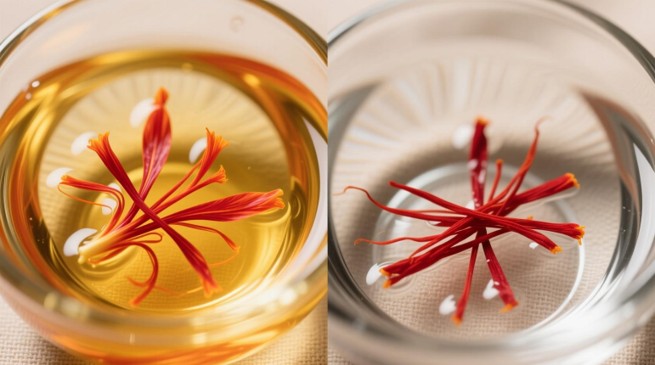
Place several saffron threads into a transparent glass containing room-temperature water. Leave them undisturbed and observe how the colour develops.
Genuine saffron generally releases a beautiful golden-yellow colour as its natural pigments dissolve. The process can take several minutes.
Artificially dyed materials may release unusually intense red or orange colour very quickly.
However, colour-release speed varies with temperature, thread condition and processing. A successful water test does not prove that saffron is pure.
2. Examine the shape of saffron threads
Authentic saffron consists of the dried stigmas of the saffron crocus.
Examine several threads closely. Genuine stigmas often have a narrow base and a slightly wider, trumpet-shaped end. Their shapes are naturally irregular rather than perfectly identical.
Artificial fibres may appear unusually straight, uniform or flat.
Some genuine commercial grades contain shorter or broken pieces, so thread length alone is not a reliable authenticity test.
A magnifying glass can help you inspect the characteristic structure.
3. What should real saffron smell like?
Genuine saffron has a distinctive and complex fragrance.
Its aroma is often described as floral, earthy, hay-like and slightly honeyed. The aromatic compound safranal contributes significantly to this characteristic scent.
Fresh saffron should smell recognisably aromatic without having an overpowering artificial perfume fragrance.
An absence of aroma may indicate old or poorly stored saffron, although some adulterated products can also contain added fragrances.
For the most useful comparison, smell freshly opened saffron threads rather than a container that has been left open for several days.
4. Can you identify fake saffron by taste?
Authentic saffron has a distinctive, slightly bitter taste rather than a sugary flavour.
A tiny quantity of known food-grade saffron infused in water can demonstrate its natural flavour profile.
An unexpectedly sweet taste or an unusual chemical flavour may indicate a problem.
However, taste is subjective and cannot distinguish every form of adulteration. Do not taste a product that you suspect contains unknown dyes or contaminants.
5. Check the colour of the threads
High-grade Iranian saffron typically contains deep crimson-red stigma material.
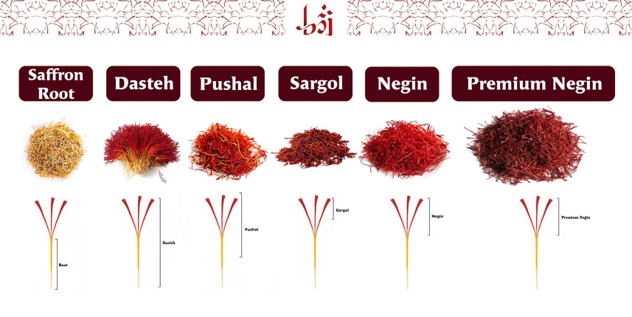
Super Negin, Negin and Sargol grades generally contain little or no yellow style, while Pushal and Dasteh intentionally retain some pale material.
Therefore, yellow sections are not necessarily evidence of fake saffron.
Be cautious of threads with unusually uniform artificial colouring or visible dye transferring onto packaging. A suspicious appearance warrants further investigation.

6. Is the paper towel test reliable?
Some shoppers place damp saffron threads on white kitchen paper to look for dye transfer.
Heavy, immediate staining in an unnatural shade may raise suspicion, but authentic saffron naturally contains powerful water-soluble pigments.
Consequently, real saffron can also stain damp paper. The test should never be used as definitive proof that a product is genuine or fake.
Combining visual inspection, aroma assessment and reliable supplier documentation is more useful than relying on one household trick.
7. Look for laboratory testing and traceability
The strongest evidence of authenticity comes from appropriate testing and a transparent supply chain.
Ask whether the supplier can provide information about the harvest, processing location, country of origin and batch number.
ISO 3632 provides internationally recognised specifications and testing methods for saffron. Laboratories can assess characteristics such as colouring strength and other quality indicators. Additional authenticity methods may be needed to detect certain sophisticated adulterants.
Part 1: Specification
+2
A certificate should correspond to the actual batch being purchased, not merely to a different product previously tested by the supplier.
Frequently asked questions
Does real saffron turn water red or yellow?
Authentic saffron normally produces a golden-yellow to orange-yellow infusion. An unusually bright red result may indicate added colouring, although colour alone cannot establish authenticity.
Can fake saffron smell like real saffron?
Yes. Added fragrances or mixtures containing some genuine saffron can imitate the aroma of authentic saffron. Smell is useful but not conclusive.
Is saffron powder more likely to be adulterated?
Powder is harder to inspect visually because the original stigma structure is no longer visible. Buying whole threads from a reputable supplier makes basic visual assessment easier.
Why is genuine Iranian saffron expensive?
Every saffron flower produces only three stigmas. Harvesting and separating them requires considerable manual labour, and drying reduces their weight further.
Can cheap saffron still be genuine?
Yes. Different grades, harvest conditions and distribution arrangements influence price. However, an unusually low price for a supposedly premium product is a reason to investigate.
Final thoughts
Learning how to spot fake saffron begins with understanding the natural characteristics of genuine saffron.
Look for recognisable stigma shapes, natural fragrance, characteristic golden colour release and trustworthy origin information.
For the greatest confidence when buying pure Iranian saffron, choose a supplier that offers transparent grading, appropriate packaging and verifiable quality documentation.